A gallstone diagnosis often brings more confusion than clarity. The pain is real, the worry is valid, but the bigger question most patients struggle with is which surgical route to take. Two options exist one that has been around for decades and one that has quietly become the global standard. If you are searching for trusted gallstone treatment in Wadala, understanding this difference could change everything about your recovery experience.
What Are Gallstones and When Is Surgery Needed?
Not every gallstone demands immediate action. Some sit quietly inside the gallbladder for years without causing any trouble. But the moment they start blocking bile flow, the body makes its discomfort very clear.
Watch out for these warning signs:
- A stabbing pain that strikes the upper right abdomen without warning
- Nausea that consistently follows a heavy or oily meal
- Bloating and heaviness that antacids simply cannot fix
- A yellow tint developing in the eyes or on the skin
- Recurring fever with no obvious explanation
When these symptoms become a pattern rather than a one-time event, surgery stops being optional and becomes necessary.
Open Surgery for Gallstones — What It Involves
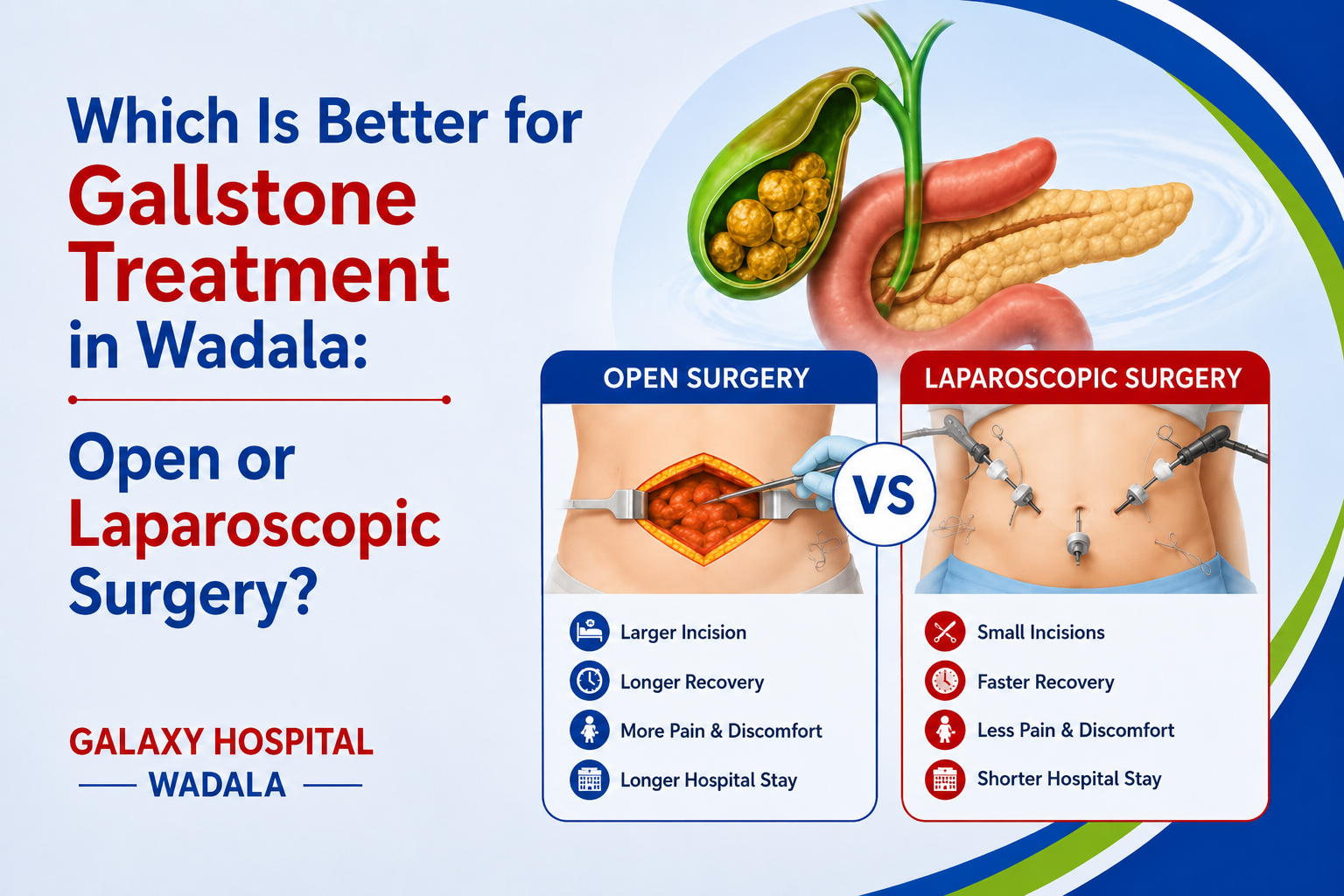
Open cholecystectomy has been performed for generations. It requires a surgeon to make a long incision across the abdomen, typically between 10 and 15 centimetres, to physically access and extract the gallbladder.
Today, this approach is reserved for situations where minimally invasive methods simply cannot work:
- A gallbladder that is severely infected or inflamed beyond safe laparoscopic access
- Internal scarring from earlier abdominal surgeries
- A confirmed or suspected malignancy in the gallbladder
- Cases where laparoscopic equipment cannot navigate safely
The trade-offs are significant:
- Patients spend 3 to 5 days admitted in hospital
- A large scar remains permanently on the abdomen
- Full recovery stretches across 4 to 6 weeks
- Post-operative pain requires stronger medication for longer
- Wound complications and infections are more likely
Laparoscopic Surgery for Gallstones — The Modern Approach
Laparoscopic cholecystectomy works through 3 to 4 puncture-sized openings in the abdomen. A tiny camera feeds live visuals to the surgical team while precision instruments do the work, all without a single large cut. The result is a procedure that is gentler on the body, faster to recover from, and far less frightening for the patient.
This is why it has become the first choice for laparoscopic surgery in Wadala at Galaxy Hospital.
Here is what patients consistently experience:
- Nearly invisible marks where the incisions were made
- Discharge from the hospital within a single day
- A return to regular daily activities within one week
- Noticeably lower pain levels throughout recovery
- Minimal chance of post-surgical infection or complications
The contrast with open surgery is not subtle it is dramatic.
Open Surgery vs Laparoscopic Surgery — A Quick Comparison
Both procedures remove the gallbladder, but the way they do it makes a huge difference to your recovery, scarring, and comfort.
Open surgery is an older method used only in complex or emergency cases. Laparoscopic surgery is the modern, minimally invasive approach preferred at Galaxy Hospital for most gallstone patients.
| Factor | Open Surgery | Laparoscopic Surgery |
| Incision Size | 10–15 cm large cut | 3–4 tiny cuts |
| Hospital Stay | 3–5 days | 1 day |
| Recovery Time | 4–6 weeks | 7–10 days |
| Scarring | Large permanent scar | Minimal, fades over time |
| Pain Level | Higher post-operative pain | Significantly lower pain |
| Risk of Infection | Higher | Much lower |
| Return to Daily Life | Takes weeks | Within days |
| Recommended For | Complex or emergency cases | Most gallstone patients |
Which Surgery Is Right for You?
No two gallstone cases are identical. The right surgical path depends on a careful reading of the patient’s complete picture — not just the stones themselves.
A skilled gallstone surgeon in Wadala at Galaxy Hospital will look at:
- The number of stones and how large they have grown
- Whether infection or inflammation is already present
- The patient’s broader health profile and any existing conditions
- Whether any past abdominal surgeries have left internal scarring
In a small number of cases, a laparoscopic procedure may need to shift to open surgery once the surgeon gets a clearer internal view. At Galaxy Hospital, every such decision is driven entirely by what keeps the patient safest.
Why Choose Galaxy Hospital for Gallstone Treatment?
Galaxy Hospital has built its reputation by providing precise, personalised gallstone treatment in Wadala while putting patients first. The surgical team has experience with both open and laparoscopic procedures. Therefore, the doctors can tailor the treatment approach to each patient’s condition rather than following a one-size-fits-all method.
The best gallstone surgeon in Wadala should offer more than technical expertise. They should also explain every step clearly, answer your questions, and help you feel informed and confident before surgery.
Final Thoughts
The difference between open and laparoscopic surgery goes beyond the surgical technique. It can also affect your recovery time, scarring, and how quickly you return to your normal routine. For many suitable patients, laparoscopic surgery offers a minimally invasive approach with several potential recovery benefits.
Therefore, do not let uncertainty delay your treatment. A consultation with the right team for laparoscopic surgery in Wadala at Galaxy Hospital can help you understand your options and choose a treatment plan that suits your condition and recovery goals.